MILLIONAIRE, DOLLAR COST AVERAGING, GOOD INVESTMENTS FOR BEGINNERS, HOW TO GET RICH FROM INVESTING, HOW TO GET RICH WITH INVESTING, INCREASE PASSIVE INCOME, PRIVATE EQUITY, WEALTH PLANNING, WEALTH SOLUTIONS
If you don’t know what to do with your money and are pained by indecision, let’s talk.
Everybody ought to have a comfortable retirement, and most people want more choices and freedom in life.
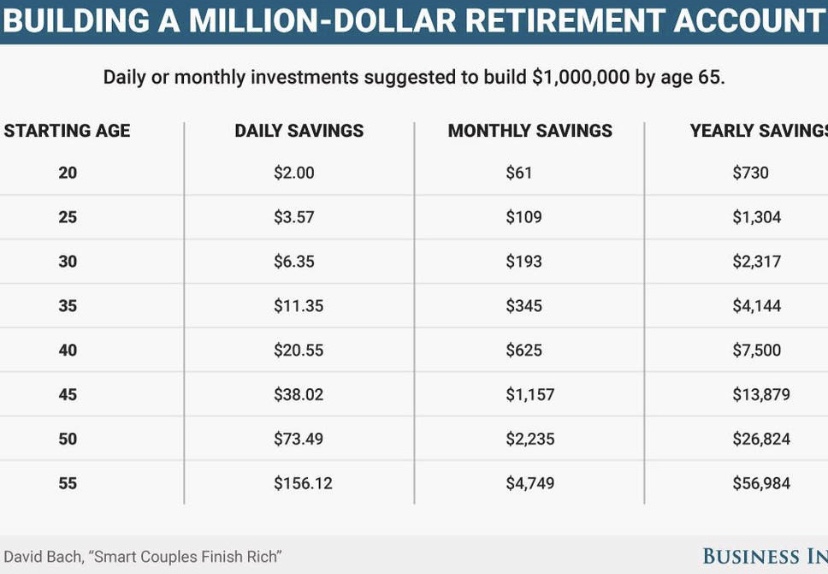
Many people want to get rich too, or at least be comfortable. The good news is that you can become a millionaire investing just $500-$1,000 a month, and a multi-millionaire investing $1,000-$2,500 a month.
The bad news is that most people fail at investing. Even some highly knowledgeable investors fail, due to human nature.
Like a doctor who can’t stop smoking or overeating, many knowledgeable people can’t resist the urge to speculate, get greedy and/or feel fearful when markets are crashing.
As a financial accountant I can help set up accounts that are:
Easy and speedy. Like you, I am frustrated by bureaucracy and time-wasting. Time is money. I am busy and I am sure you are too. My aim is to save you time and money by doing things online as quickly and effortlessly as possible.
Give you access to some of the biggest fund houses in the world – including Vanguard, BlackRock and iShares.
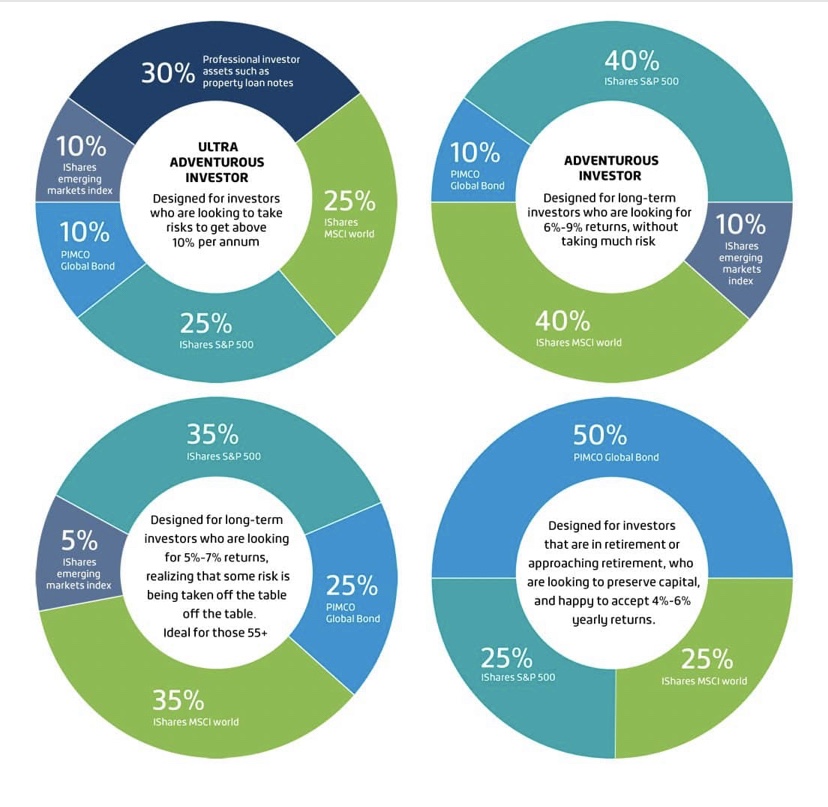
Adjusted to your risk tolerance: the four portfolios below are examples of past portfolios I have constructed, to adjust for client’s risk-appetite:
Have reasonable account minimums: Since March 30, 2021, I increased my minimums to deal with me directly. There are now three service levels.
Based on the 80:20 principle – 80% in core assets. 20% in assets that you can’t get access to directly (for example private equity).
Reasonable account fees: 1% yearly management fees. 0.75% on accounts above $500,000, and 0.5% on accounts above $1m.
Globally available: for everybody except people living in Americans (American expats are OK) and a few other countries. Accounts are particularly useful for expats who are moving from country to country, and locals living in emerging market countries, where there is not a stable currency and system in place.
In your company name if applicable – accounts can be in your name or your company name. If you own a company investing through your firm can be tax efficient.
For kids’ education – your kids can be the primary beneficiary on the accounts.
The accounts aren’t for everybody. They certainly aren’t for people who prefer to speculate and engage in get rich quick schemes.
If you need help with financial planning get in touch with me using the various contact methods on my home page or at the bottom of this window and I will help you with your investment strategy.
She isn’t an exception either. I personally know several “millionaire next door types” that have middle-incomes but have become rich slowly,
By the same token, it is a huge mistake to assume that investing is a get-rich-quick scheme.
It simply isn’t. You will have good and bad years, and even the occasional “lost decade” if you invest.
You will have to face countless moments like this:
Market crashes. The Stock Market has crashed 40%-50% on countless occasions, even though the Dow Jones has gone from 60 in 1900 to 2,000 in the early 90s to 26,000–29,000 this year.
If you are long-term orientated, that doesn’t matter though. The markets are like a rollercoaster where the general trend is up sharply, but with many bumps along the way. But basically working with a regulated and secured platform, you won’t have to worry about checking up the market as it prefectural handled and in check to do so ensuring you don’t lose like you do trading alone because you don’t have the risk insurance to cover your losses… Feel free to reach out to perfectly understand and get involved with smoothly profiting system
An investment is an asset or item acquired with the goal of generating income or appreciation . Appreciation refers to an increase in the value of an asset over time. When an individual purchases a good as an investment, the intent is not to consume the good but rather to use it in the future to create wealth. An investment always concerns the outlay of some asset today—time, money, or effort—in hopes of a greater payoff in the future than what was originally put in.
For example, an investor may purchase a monetary asset now with the idea that the asset will provide income in the future or will later be sold for a higher price for profit.
KEY TAKEAWAYS
An investment is an asset or item that is purchased with the hope that it will generate income or appreciate in value at some point in the future.
An investment always concerns the outlay of some asset today (time, money, effort, etc.) in hopes of a greater payoff in the future than what was originally put in.
An investment can refer to any mechanism used for generating future income, including bonds, stocks, real estate property, or a business, among other examples.
How an Investment Works
The act of investing has the goal of generating income and increasing value over time. An investment can refer to any mechanism used for generating future income. This includes the purchase of Bonds, stocks, or real estate property, among other examples. Additionally, purchasing a property that can be used to produce goods can be considered an investment.
In general, any action that is taken in the hopes of raising future revenue can also be considered an investment. For example, when choosing to pursue additional education , the goal is often to increase knowledge and improve skills (in the hopes of ultimately producing more income).
Because investing is oriented toward the potential for future growth or income, there is always a certain level of risk associated with an investment. An investment may not generate any income, or may actually lose value over time. For example, it’s also a possibility that you will invest in a company that ends up going bankrupt or a project that fails to materialize. This is the primary way that saving can be differentiated from investing: saving is accumulating money for future use and entails no risk, whereas investment is the act of leveraging money for a potential future gain and it entails some risk.
Types of Investments
Economic Investments
Within a country or a nation, economic growth is related to investments. When companies and other entities engage in sound business investment practices, it typically results in economic growth.
For example, if an entity is engaged in the production of goods, it may manufacture or acquire a new piece of equipment that allows it to produce more goods in a shorter period of time. This would raise the total output of goods for the business. Taken in combination with the activities of many other entities, this increase in production could cause the nation’s gross domestic product (GDP) to rise.
Investment Vehicles
An investment broker provides a variety of services to individuals and businesses, including many services that are designed to assist individuals and businesses in the process of increasing their wealth.
Investment banking may also refer to a specific division of banking related to the creation of capital for other companies, governments, and other entities. Investment banks underwrite new debt and equity securities for all types of corporations, aid in the sale of securities , and help to facilitate mergers and acquisitions , reorganizations, and broker trades for both institutions and private investors. Investment banks may also provide guidance to companies who are considering issuing shares publicly for the first time, such as with an initial public offering (IPO).
Investing vs. Speculation
Speculation is a distinct activity from investing. Investing involves the purchase of assets with the intent of holding them for the long-term, while speculation involves attempting to capitalize on market inefficiencies for short-term profit. Ownership is generally not a goal of speculators, while investors often look to build the number of assets in their portfolios over time.
Although speculators are often making informed decisions, speculation cannot usually be categorized as traditional investing. Speculation is generally considered a higher risk activity than traditional investing (although this can vary depending on the type of investment involved). Some experts compare speculation to gambling, but the veracity of this analogy may be a matter of personal opinion.
Frequently Asked Questions
How is an investment different from a bet or gamble?
In an investment, you are providing some individual or entity with funds to be put to work growing a business, starting new projects, or maintaining day-to-day revenue generation. Investments, while they can be risky, have a positive expected return. Gambles, on the other hand, are based on chance and not putting money to work. Gambles are highly risky and also have a negative expected return in most cases (e.g., at a casino).
Is investment the same as speculation?
No. An investment is typically a long-term commitment, where the payoff from putting that money to work can take several years. Investments are typically made only after due-diligence and analysis has been undertaken to understand the risks and benefits that could unfold. Speculation, on the other hand, is a pure directional bet on the price of something, and often for the short-term.
What are some types of investments I can make?
Most ordinary individuals can easily make investments in stocks, bonds, and CDs. With stocks, you are investing in the equity of a company, which means you invest in some residual claim to a company’s future profit flows and often gain voting rights (based on the number of shares owned) to give your voice to the direction of the company. Bonds and CDs are debt investments, where the borrower puts that money to use in a pursuit that is expected to bring in cash flows greater than the interest owed to the investors. Gold and silver, currencies of leading nations are investment that appreciate daily over constant price selling and buying, proven to be so profitable in the recent market.
Why invest when you can save money with zero risk?
As mentioned, investing is putting money to work in order to grow it. When you invest in stocks or bonds, you are putting that capital to work under the supervision of a firm and its management team. Although there is some risk, that risk is rewarded with a positive expected return in the form of capital gains and/or dividend & interest flows. Cash, on the other hand, will not grow, and may very well lose buying power over time due to inflation. Put simply, without investment, companies would not be able to raise the capital needed to grow the economy which lead to inflation and company downsizing.
Bitcoin (BTC) trading around $60,120.82 as of 20:00 UTC (4 p.m. ET). Climbing 0.68% over the previous 24 hours.
Bitcoin’s 24-hour range: $59,428.21-$61,219.72
BTC trades between its 10-hour and 50-hour averages on the hourly chart, a sideways signal for market technicians.
Bitcoin surged early Monday to a four-week high of $61,219.72. Analysts said the largest cryptocurrency might have gotten a boost from the hoopla surrounding U.S. exchange giant Coinbase’s coming direct stock listing Wednesday.
In cryptocurrency circles, the “Coinbase effect” is when a digital token gets a price pump after getting listed on the cryptocurrency exchange. But bitcoin might get the benefit of a different type of “Coinbase effect” – if newbie investors, spurred by mainstream press coverage of the stock listing, decide to put money into cryptocurrencies.
“The Coinbase hype within crypto, in terms of valuation and its domino effect on other markets” means Wednesday’s direct listing might become “a key catalyst event,” Singapore-based crypto quant firm QCP Capital wrote Monday on its Telegram channel.
The cryptocurrency analysis and data site IntoTheBlock wrote in a newsletter last week that “anticipation” of the Coinbase stock listing “has contributed to broader risk-on sentiment throughout crypto.” A week ago, the market value of all cryptocurrencies surpassed $2 trillion for the first time.
QCP noted that bitcoin prices, despite doubling so far this year, have underperformed the Standard & Poor’s 500 Index of large U.S. stocks in the past month, so a successful Coinbase listing might lead to a reversal.
Cryptocurrency analysts also are studying a key blockchain data metric that’s seen as bullish: bitcoin’s liquid supply changes.
According to the analyst Willy Woo, more bitcoins are turning from liquid status to illiquid, meaning they’re getting withdrawn and locked away into long-term holding patterns.
That means there might be less supply to go around for new bitcoin buyers, potentially offsetting what appears to have been a recent slackening of demand.
On the other hand, Coindesk reported that net inflows to digital asset investment products declined last week by $23 million to $83 million.
Bitcoin’s market dominance at the same time dropped to around 55.6%, the lowest level since April 2019 – potentially an indication that more investors have shifted their focus to alternative cryptocurrencies (altcoins).
Ether and altcoins
Ether (ETH) trading around $2,144.59 as of 20:00 UTC (4 p.m. ET). Climbing 0.04% over the previous 24 hours.
Ether trades between its 10-hour and 50-hour averages on the hourly chart, a sideways signal for market technicians.
Ether hit a new all-time high price at $2,199.87 during trading hours in Asia Monday, but exchange tokens including Binance’s BNB and Uniswap’s UNI stole the thunder with staggering double-digit percentage gains.
BNB was up more than 15% in the past 24 hours, while UNI was up more than 20%, according to Messari.
The exchange tokens’ rally in the past month is a “spillover” from Coinbase’s listing, according to QCP, which warned that the fuss surrounding the event could lead to “too much short-term froth” in the crypto market.
Binance, the biggest crypto exchange in the world by trading volume,announced on Monday it is now offering a zero-commission tokenized stock trading service to its users, with prices settled in Binance’s own U.S. dollar-linked stablecoin, Binance USD (BUSD).
Other digital assets on the Coindesk 20 are mixed. Notable winners as of 20:00 UTC (4:00 p.m. ET):
Cardano(ADA) + 3.71%
Cosmos (ATOM) + 3.07%
Omg network (OMG) + 1.22%
Notable losers:
Stellar (XLM) – 5%
Ethereumclassic(ETC) – 4.07%
Eos (EOS) – 3.59%
Kyber network(KNC) – 3.55%
Other markets
Equities:
Asia’s Nikkei 225 closed in the red 0.77%.
The FTSE 100 in Europe was down by 0.39%.
The S&P 500 in the United States closed in red 0.02%.
Commodities:
Crude oil (WTI): +0.66% to $59.71/barrel.
Gold: -0.7% to $1732.08/ounce.
Treasurys:
The 10-year U.S. Treasury bond yield climbed Monday to 1.672%.
On Friday, I had the privilege of speaking at the annual strategic investment symposium run by the College of Charleston in South Carolina. Sadly, like everything else over the past year, the conference was virtual and so I couldn’t revisit Charleston itself. Just to rub it in, the host let me know that it was sunny day in Charleston, with a high expected in the mid-to-upper 70s.
I can imagine an attendee, after earnestly absorbing the morning’s proceedings, taking advantage of the fine weather and settling into a comfortable chair on his veranda with a cool drink and some easy reading near at hand. But as the afternoon drew to a close, he would have packed up with care, as rain was expected that evening.
Small preparations for a small weather event.
However, the people of Charleston are well aware of nature’s fuller fury and families that have survived the many hurricanes that have battered the city over the generations take more serious long-term precautions. Storm shutters, reinforced roofs and steel doors are standard equipment. Extra care is taken to trim trees and clear gutters. And, as hurricane season approaches, careful attention is paid to the tropical forecast.
For investors, markets last week seemed like a spring day in Charleston, with the stock market drifting up to a new record high and long-term interest rates settling down after a steady rise from August of last year to early March. However, in the short run, investors need to recognize the potential for some headwinds from higher inflation and higher taxes. In addition, while no greater crisis appears imminent today, investors need to be prepared for the risk of a more significant surge in inflation and taxes in the years to come.
Inflation in the short run.
The week ahead should provide further evidence of a strengthening in near-term inflation pressures. We expect Tuesday’s CPI release for March to show a 0.6% gain overall and 0.2% excluding food and energy. This should boost year-over-year inflation by these measures to 2.6% and 1.5% respectively.
These year-over-year numbers are set to rise further in April, since prices fell sharply in April 2020 as the pandemic took hold. Because of this, inflation, even using the Fed’s preferred consumption deflator measures, is likely to exceed 2% on a year-over-year basis for the rest of 2021.
However, quite apart from base effects, there are some building areas of inflation pressure. Purchasing manager surveys, in both manufacturing and services, show very strong increases in the cost of inputs as bottlenecks restrict supplies. Oil prices have climbed in recent months reflecting both a pickup in global demand and some production discipline on the part of OPEC and Russia. Wage growth could remain relatively healthy in the months ahead as employers, staffing up for improved demand, will have to at least match the income provided to unemployed workers by enhanced unemployment benefits through September. Perhaps most importantly, almost $1.2 trillion in federal spending under the recently passed American Rescue Plan Act should make it easier for companies of all kinds to raise their prices.
Our base case assumption is that widespread vaccinations, along with the immunity acquired by many from contracting Covid-19, allows the pandemic to wind down over the summer, with most normal economic and social activity resuming by the fall. If this occurs, the economy should see a very strong surge in economic growth throughout this year, with unemployment falling to 4% in early 2022. However, beyond that point, barring further fiscal stimulus, growth should slow down and this could allow inflation to settle at the “a little above 2%” level that the Federal Reserve is targeting. Even this, however, should be consistent with long-term interest rates rising further, as the Fed begins to taper bond purchases early next year. In addition, there is a distinct possibility that inflation could burn a little hotter if further fiscal measures pass Congress aimed at providing additional support to low and middle income families.
While much of this scenario would be very welcome, these somewhat higher rates would, of course, inflict losses on fixed income investors and could motivate a further rotation from growth to value within the equity market.
Taxes in the short run.
There is also a rising risk of higher taxes in the year ahead. President Biden has already outlined a proposal for higher corporate taxes to finance his infrastructure plan. This proposal includes an increase in the corporate tax rate from 21% to 28% and the adoption of a global minimum corporate tax of 21%. In addition, he is widely expected to propose increases in income and capital gains taxes on upper income individuals to finance an extension of recently passed enhancements to the child, dependent care and earned income tax credits.
Some of these proposed tax increases are likely to get watered down. In particular, one key Democratic senator appears opposed to pushing the corporate income tax above 25% while other countries with whom the U.S. would have to negotiate an global minimum corporate tax, would likely balk at a rate as high as 21%.
That being said, there is a good chance that legislation increasing both the corporate income tax rate and capital gains taxes for upper income households will pass before the end of the year. As in the case of inflation, it is hard to argue that markets have already “priced this in” and the passage of tax increases could represent a challenge to capital markets over the next year.
As in the case of inflation, however, there should be a short-term limit to the trend towards higher taxes. If Democrats lose five or more seats in the House of Representatives in the November 2022 mid-term elections, they will lose control of the House. History suggests that the odds are stacked heavily against them, as the President’s party has lost 5 or more seats in 18 of the last 21 mid-term elections going all the way back to the 1930s. If this transpires, further tax increases would likely be off the table. In addition, a Republican-controlled House would like block any further significant fiscal stimulus, cooling down both economic growth and the threat of inflation.
Inflation and taxes in the long run.
Prospects for higher inflation and taxes in the short run are real and should have real consequences in raising long-term interest rates and curtailing equity market returns, particularly on stocks with high valuations today.
However, investors should also recognize that there are longer term threats.
On the inflation front, decades of rising inequality have simultaneously contributed to rising asset prices while reducing the demand for goods and services. As we show on page 25 of The Guide to the Markets,the value of all U.S. financial assets has now climbed to over six times GDP compared to between two and three times from the 1950s to the early 1990s. At some stage, either because of deliberate efforts to redistribute wealth or because holders of assets become nervous about their value, we could see substantial pressure to sell assets and buy goods and services, resulting in substantially higher inflation and falling real asset prices such as occurred in the 1970s.
On taxes, it is worth noting that the national debt has now more than tripled as a share of GDP since the start of the century, with little evidence that either major political party in Washington sees this as a problem. Nor is it a problem, so long as interest rates remain close to zero. However, interest rates could rise substantially if inflation begins to accelerate and the Federal Reserve feels forced to adopt a hawkish stance for the first time in decades. Very high interest rates, which are suddenly sensitive to the level of the deficit, could force a future administration to raise revenues much more aggressively. Given political realities, such tax increases would very likely include higher taxes on corporations and capital gains, posing a significant challenge to investors.
These are scary and certainly premature thoughts for an economy just recovering from disaster. Still, investors would be well advised to check their exposure to higher inflation by limiting the duration of their fixed income assets and making sure they can participate in any further rotation from growth to value. In addition, it is important to keep an eye on Washington and the world. If the U.S. continues to push the envelope more than other nations in fiscal stimulus and deficit financing, investors may want to increase their exposure to overseas equities where valuations are cheaper and a less exuberant boom today could provide the comfort of a less painful bust in the years to come.
Disclosure
Any performance quoted is past performance and is not a guarantee of future results.
Diversification does not guarantee investment returns and does not eliminate the risk of loss.
Opinions and estimates offered constitute our judgment and are subject to change without notice, as are statements of financial market trends, which are based on current market conditions. We believe the information provided here is reliable, but do not warrant its accuracy or completeness. This material is not intended as an offer or solicitation for the purchase or sale of any financial instrument. The views and strategies described may not be suitable for all investors. This material has been prepared for informational purposes only, and is not intended to provide, and should not be relied on for, accounting, legal or tax advice. References to future returns are not promises or even estimates of actual returns a client portfolio may achieve. Any forecasts contained herein are for illustrative purposes only and are not to be relied upon as advice or interpreted as a recommendation.
Well, I wish I could answer that in Yes or No. However, all the concerns mentioned in the questions are very valid, but are mutually exclusive events except stock market (which is impacted by everything). Let me take time and address them individually.
The most immediate reason for gold’s woes is the strong dollar. Gold is priced in dollars, so if the American currency goes up, investors mark down the yellow metal accordingly. An added factor is that the dollar is rising because of the revival of the American economy, which is bringing the prospect of higher interest rates. That is bad news for gold. Higher interest rates increase the opportunity cost of holding zero-yield assets: the money tied up uselessly in bullion could be earning a return if invested in treasury bills or other debt. Strong corporate earnings have a similar effect: when dividends are generous, it hurts more to miss out on them. Iron ore, Rubber and other material prices are down. Its not gold alone.
Greece has been in and out of trouble for long time. The country needs severe economic reforms. Its simple, they consume more than they produce as a country and cannot keep up with the credit payments like you and me can. (Btw, 25 States in U.S have more GDP than Greece. So, dont worry about it)
Oil prices have a thousands of argument but its simple the demand and supply logic. Top suppliers wont cut the oil production to hike the prices. They instead chose lower prices keeping the supply same. Also with the development in batteries, increase of solar energy and efficient engines (all kinds) the demand and prices will further go down.
The stock market rally was clearly sponsored by the Chinese government. It all started with the widely trumpeted announcement of the Shanghai – Hong Kong Stock Connect last year to help Chinese corporates raise equity beyond the Mainland, with the announcement of a huge number of IPOs following suite. The underlying reason for the Chinese to push the stock market at that time was that Chinese banks and corporations needed a venue to raise equity after an era of excessive leveraging. Yet neither the Shanghai nor the Hong Kong stock market was well placed after years in a bear market. The sudden collapse of the Chinese stock market had two triggers. First, the was a wave of profit taking after the Shanghai benchmark index broke through 5 000 in early June and doubts emerged about further easing from the PBoC. At that very same moment, China’s securities regulator announced measures to cool down the market, which amounted to banning brokerage firms from providing unregulated margin funding to investors. This was more of a shock to the system than one might imagine, as margin financing in China is much larger than in other stock markets.
Final Take: Market is unpredictable. But surely always favorable
Investing in gold for the future is a wise decision. Gold is a wise investment because many investors feel secure with it during bad economic times. Gold will also increase in value while stocks sometime decrease.
Smart investors know currency does not carry the same value it once did in previous years. Gold is becoming the wisest way for many people to have a more secure future.
Purchasing gold is a trend that should continue as the dollar slowly declines in value. The economy is uncertain with china and USA engaging in trade wars. However, more people are becoming interested in how to invest in gold.
Should You Buy Gold?
This a very important question you must carefully consider, before making a major risk taking decision. Why? because there is important information, you should be informed about before investing in stock.
Here are three steps that could possibly help guide you in making more informed decisions.
1. You should first contact experienced gold brokers about your desire to purchase gold bullion or gold certificates.
2. Research various companies online that buy and sell gold. They are sometime less expensive and easier to gain access, if you decide to sell your gold at a later time.
3. Search reviews about a company and gather as much information as possible before buying gold from them. Also, if possible seek customer reviews.
If you don’t feel comfortable with your decision, wait for the right time or seek more information about purchasing gold.
What Type of Gold Should You Invest In?
A very important question, because it is available in several types. Here are two choices listed that can help you get started.
Gold Coins are a great investment to pass on to your children and grandchildren. It can also help with your pension during retirement years.
Gold Bars are another way to wisely invest your money. In fact gold bars can be more efficient that gold coins. They are also more popular globally and available in a variety of weights.
Is the Time Right For Gold Investment?
Yes the time is right for some people, but NOT for everyone.
You should carefully consider your situation and not solely on what other people are doing for their lives. There are many factors to consider such as inflationand trends about gold prices.
Don’t make a hasty decision about gold investments, send a dm and know more on how your portfolio can be handled
Cryptocurrency is a new form of digital money. You can transfer your traditional, non-cryptocurrency money like the U.S. dollar, Euros and other form of currency digitally, but that’s not quite the same as how cryptocurrencies work. Cryptocurrencies has become mainstream, you may be able to use them to pay for stuff electronically, just like you do with traditional currencies, most big companies are investing huge amounts making it the fastest growing commodity in the market both long and short term investment under proper management.
What’s the definition of money? Before getting into the nitty-gritty of cryptocurrencies, you need to understand the definition of money itself. The philosophy behind money is a bit like the whole “which came first: the chicken or the egg?” thing. In order for money to be valuable, it must have a number of characteristics, such as the following:
Enough people must have it.
Merchants must accept it as a form of payment.
Society must trust that it’s valuable and that it will remain valuable in the future.
Of course, in the old days, when you traded your chicken for shoes, the values of the exchanged materials were inherent to their nature. But when coins, cash, and credit cards came into play, the definition of money and, more importantly, the trust model of money changed. Another key change in money has been its ease of transaction. The hassle of carrying a ton of gold bars from one country to another was one of the main reasons cash was invented. Then, when people got even lazier, credit cards were invented. But credit cards carry the money that your government controls. As the world becomes more interconnected and more concerned about authorities who may or may not have people’s best interests in mind, cryptocurrencies may offer a valuable alternative.
What are the benefits of investing money? Let’s understand the benefits of investing money Let me start with a small story There were two persons Mr.X and Mr.Y. Both had an ambition to lead a happy and prosperous life. They started working in the same company and their take-home pay per month was 200,000. They both started working at the age 25 and they would get retired at the age of 58.
Mr.X
•Mr. X didn’t have any financial knowledge and he thought he is getting attractive salary to lead a happy life
•He did not invest in any of the financial assets
•According to him, financial wealth is all about having luxurious goods such as iPhone, costly bikes and cars. So, he spent all his money in buying those goods. As the years went, all these physical goods lost their value (Depreciation)
•Till his retirement, he had money in his hand and he was leading life with that money. After retirement, he didn’t have any clue on how he would lead his remaining life.
Mr. Y
•Mr. Y on the other had some knowledge on personal finance and money management which he gained through by reading books on investing
•He started to invest 180000 per year till his retirement
•He diversified his savings in different financial instruments like bonds, Mutual Funds, PPF, stocks. His average returns was 10% per year
Investing in Digital Cryptocurrencies vs Traditional Stocks The consistent technological advancements in the past decade have effectively transformed the way younger generations perform tasks ranging from the mundane to the complex. It has also widened their tolerance and acceptance of trying out “risky” or new things, such as investing in digital currencies.When blockchain erupted a decade ago and the first cryptocurrency was born, it was met with a lot of skepticism. New currencies emerged, and some even crashed (and resurrected), but these ethereum seem like they’re here to stay. People became curious and more open to studying the world of virtual currencies, and eventually began utilizing them for trading and acquiring goods. In a survey of 1,000 online cryptocurrency investors, it was revealed that 43% of millennials have more faith in the crypto market than traditional stocks.Now, traders are becoming more and more interested in the world of cryptocurrency investment rather than the traditional stock market, because of the higher potential returns. But how accurate are these claims? It’s time to dive in and discover the similarities and differences between the two. Cryptocurrency has changed the business world by adding another asset that individuals and organization can invest in. Although only 3% of people currently trade with digital money, the number of investors is growing steadily across the globe.Investing in cryptocurrencies has always been, and is still the easiest way to earn big money. However, when it comes to digital money, the market is highly unstable, and the number of the failing projects outweighs potentially successful ones.
Top 2 cryptocurrency worth investing? BITCOIN (BTC) The list of the most promising cryptocurrencies will not be complete without bitcoin. It’s like talking about content creation services and not mentioning market leaders. BTC is by far the largest coin, owning more than 75% of the market share. Bitcoin remains in a completely unique position, which cannot be said about other cryptocurrencies. Bitcoin is still seen as an image of the cryptocurrency as a whole and as a representative of the cryptocurrency market. Bitcoin is unlikely to lose its status too quickly, so BTC remains one of the safest and best cryptocurrencies to buy right now. 1BTC = $55 reaching it’s all time high this year.
ETHEREUM Ethereum is based on a popular dApp processing platform, which is exactly where it derives its power from. According to live price tracker, this coin currently costs over $2000, but the 2021 predictions are optimistic. Some analysts even claim that Ethereum can even reach half of the worth of bitcoin Bitcoin. Although we disagree with this statement, we also believe Ethereum is going to grow next year. This is best for a long term investment plan, bitcoin tripled in worth within 2 months and with the rate of acceptance of cryptocurrency, the same would be said about ethereum.. How to earn from cryptocurrency The whole basic is this; So let’s say today 1 BTC equals $1. So let’s say you purchase 1 BTC for $1 and then tomorrow 1 BTC equals $5 noting that Bitcoin (BTC) has gained value over the dollar. So now, if you sell your bitcoin the next day you get $5 instead of your initial $1. But imagine if you use larger amounts for this trade?
The volatility of the worth of cryptocurrency has been a major strategy used by the platform to ensure profits are made with each transaction, this is made possible with the us an AI( Artificial intelligence ) which help In the trading sessions reducing the risk of lost of investment and besides the assistance of the A.I your account, You will be totally in control of this process as you tend to see where your money is been invested, what is been done on your investment account as well as deposits and withdrawals are entirely controlled by you. Let’s give an instance that the value of 1BTC equals $30k and the A.I predicts a rise in the worth of bitcoin, (the A.I and an account manager usually work hand in hand in handling the trading session providing the outstanding productivity The advantages of our A.I software is that it can help detect the drop in the price of the cryptocurrency and convert it directly to USD reducing the amount to be lost.. Let’s assume a trader wants to open/close BTC/USD trade and believes that the BTC will appreciate against the USD (another way of thinking of it, is that the BTC will gain more value relative to the USD). The trader buys the BTC/USD at 1btc/$30k and purchase $30k worth of USD currency. Later that day the price has increased to from $30k worth of BTC to about $35000, the trader is up with $5000 . But If the price dropped to $25000, the trader would be losing $5000, that’s the risk involved in any investment plan, the ability to accept failure and the predictions are always 75% accurate most time..so the risk of losing your capital is slime but your ROI could be massively BTC has a 15% chance of becoming a long-term trusted store of value, it is a good investment with a nice expected return Early bitcoin disciples and enthusiasts are super smart, great at marketing, and mostly were already very wealthy before bitcoin. Bitcoin is, of course, the most popular cryptocurrency in the crypto industry. The surge in users and global expansion of the industry can be undoubtedly credited to Bitcoin. But lately, what started as a medium of exchange, uninfluenced by banks and financial institutions, is getting recognized as a classical asset class. Bitcoin had an exciting end in 2020 and reached a peak of 25000 USD by early 2020, But crashed down during March and now it’s currently worth more than $55k. when cryptocurrencies led by Bitcoin witnessed a serious price plunged along with share markets around the globe, This came as no shocker for many crypto enthusiasts individual Bitcoin has been around for 7 years and has never been hacked. That is a ‘store of value’ that can count. To change 1 unit in Bitcoin’s blockchain you need over $ 30 billion. Bitcoin will be the gold – the safe haven – of the new generation. This can cause a liquidity spike at some point. And then Bitcoin can even rise to $ 75,000 per BTC There is a finite number of Bitcoins that will ever exist. You can mine gold and continue to mine every year. To mine gold, you need investments. So gold is better than fiat money. But Bitcoin is a math miracle and no one can change math. That’s why Bitcoin is better than gold Bitcoin grew at a rate of 0.484095526 % per day from 2017-07-17 to 2020-12-31 to get from $ 2,244.27 to $ 1,000,000.00. Bitcoin is scarce. There will only be 21 Million BTC. If every Millionaire in the world wants one, there are not enough for every one to have a whole BTC.The more people adapt the buying of bitcoin will increase worth, This technology is still at a relatively early stage, and at a perfect stage to have in investment to be part of the growth. With the aid of an A.I and professional traders like team, we have a 75% success chance in every trade, The use of Artifical intelligence is limitless. It has already impacted almost any segment of our lives. It helps us get feedback from brands in real time it minimizes the risk of human error and automates most of our daily activities; it improves the most human invention , we take on our smartphones; it assesses our creditworthiness, and so forth. Risk management we very much know that Risk Management is quite very much fundamental in successful trading and portfolio management. And even at that, the system is designed that if peradventure we meet an unforeseen circumstances as the market is full of unimaginable surprises, a customer can still get to take his/her capital and at least 5% profit from his/her total stake. To minimize the risk of failure, traders rely on AI. Stats emphasize that 90% of successful forex traders today use robots to make money. These innovative technologies allow them to analyze massive amounts of data effortlessly, track their performance in real-time, streamline trading processes and, therefore, make wiser trading decisions in the future.One of the major benefits of implementing AI into forex is machine learning and predictive analysis . The benefits of working with my Platform ‘Financial Broker’ First off what’s a broker ?A brokerage company’s main duty is to act as a middleman that connects buyers and sellers to facilitate a transaction. Brokerage companies typically receive compensation by means of commissions or fees that are charged once the transaction has successfully completed. ——-have improved their client services over the years. Opening a forex trading account is usually quite simple and can be done online. Before trading, a forex broker will require customers to deposit money into their account as collateral. However, the broker also provides leverageto customers so they can trade larger amounts than what is deposited in their account. Depending on the country the traders are trading from, that leverage can be 30 to 400 times the amount available in the trading account. High leverage makes forex trading very risky and most traders lose money attempting to trade in this way, My platform works with a 10:500 leveage , and any loss made will be incase an lose of trade the company will Benefits of leveraged trading Leverage allows you to open a position without have to pay its full value upfront. A trade on USD/BTC and EUR/BTC, for instance, might only require 0.5% of the total value of the position to be paid in order for it to be opened,Leverage allows you to get exposure to large amounts of currency without having to commit too much capital. The brokers are compensated two ways; firstly through the bid-ask spread of a currency pair. For example, when the Euro-U.S. Dollar pair is priced as 1.20010 bid and 1.20022 ask, the spread between these two prices is .00012, or 1.2 pips. When a retail client opens a position at the ask price, and then later closes the position at the bid price, the forex broker will have collected that spread amount. Secondly, brokers may charge additional fees. Some may charge a fee per transaction or a monthly fee for access to a particular software interface, or fees for access to special trading products such as exotic options. The platform is regulated by the FCA (Financial Conduct Authority) in the UK, CySEC (Cyprus Securities and Exchange Commission) in Cyprus, ASIC (Australian Securities and Investments Commission) in Australia or SEC (Securities and Exchange Commission) in the US..The benefit of choosing a regulated broker is that this will ensure that you, as a trader, are protected to the full extent of the law in every country..
Fractional investment reduces the minimum investment barriers so that nearly everyone out there can purchase cryptocurrencies I keep telling friends how bitcoin could or is already the next gold The best thing to do is to invest now and smile tomorrow.As long as Bitcoin continues to dominate the cryptocurrency market, investors will always benefit from high liquidity levels. Even during periods of market uncertainty. Over the years, Bitcoin has shown a volatile yet consistent growth. Having over 2 btc earned through investment opportunities wouldn’t be something you’d regret You’ll regret not earning as much btc as you should have got Did you know that the bank flips the money that’s sitting in your bank account by trading with other currencies from other countries with forex I mean think about it ….Really think about it Think about how much money people deposit and withdraw at a time Now think about a currency that has no boundaries and is fully independent of a central system Banking institutions provide an essential bridge between depositors and borrowers. By accepting deposits and putting those funds into income-earning investments,How they invest their funds determines their profitability. There are over 6,000 commercial banks, savings and loan associations, and savings banks that accept deposits and invest those funds within the parameters allowed by federal and state agencies.The balance can be invested in real estate loans, commercial and consumer loans and government securities,stocks and binary with the banks’ profit determined by the spread between what is earned on their investments How the platform will be able to help individual investors The provision of an account manager, who’s an account manager ?Account management responsibilities include developing strong relationships with customers, connecting with key business executives and stakeholders and preparing sales reports. Account Managers also answer client queries and identify new business opportunities among existing customers. And a transparent work ethics.with a liscened account manager, they offer experience, which can only be gained through long-term involvement in the markets, is the only asset that can reduce or even negate the large risks associated with currency/crypto trading, since a beginner lacks such a background by definition. The account manager will be charged with ensuring adequate satisfaction of his clients by making successful transactions. He/she is also responsible for making transaction decisions, takes care of the opening and closing of deals, identification of opportunities corresponding to the account he runs and the proper day to day running of this deal until its completion. The key to wealth is investing If you’ve ever considered earning then I’d explain better get some real good info , ignorance is not a excuse in life. How the profits are been made for investors Short-Term Cryptocurrency Investment Short-term investments are remodeled in shorter time periods with the hope of creating quick profits. So, just how short maybe a short-term investment?
Short-term investments can take seconds, minutes, days, or maybe a couple of months. How Do Short-Term Investments Work? Just like long-term investing, you would like to possess clear goals for your investment. you would like to be asking yourself :
What profit are you expecting to form from this investment? this may offer you a thought of the worth at which you ought to buy/sell the cryptocurrency.
How much of a loss will you accept? this may assist you to control your losses if the worth of cryptocurrency suddenly drops.
Do you have time to review and follow the crypto market and therefore the news?
Can you make technical analyses of the crypto market? If not, then you ought to learn before investing.
Will your short-term strategy offer you higher returns than a long-term strategy?
Low market cap;
High trading volume — many people are buying and selling it every minute;
Are currently trending on the news and on social media;
Have an ICO or have just finished their ICO — attempt to get them at a coffee price.
While cryptocurrencies like Bitcoin and Ethereum also can be traded within the short-term, you ought to believe in investing within the newer cryptocurrencies. Investors have made huge profits within the past with short-term investments – including a number of the main, but newest cryptocurrency investments like NEO, Stellar, IOTA, and NEM. The main advantage of short-term investments is that you simply can make tons of cash during a short amount of your time — they need made tons of individuals rich quickly. However, they still have their disadvantages. So, what are they?
They take up tons of your time and energy as you would like to observe the market prices constantly; which has been made easier with the aid of the account managers, it gives you the legure of not having not alter your daily schedule. Have your money work for you letally.
It is a riskier investment and may end in greater losses due to what proportion the worth changes during a short time; with the use of AI we have been able to react quickly to any change in the market to conserve the capital, that’s the primary purpose of the A.I , any decision made is to conserve the initial capital.
It is often very stressful and emotional when handled by non professionals
If you actually believe in a project, then I like to recommend that you simply invest within the future. However, if a project is new and is generating tons of attention, then short-term trading might be the higher option. Now if you’ve got any interest in short-term investments and my platform provides a reliable bitcoin investment trust whose transactions are validated using cryptography, which simply is that the science of encrypting and decrypting information.
Let’s say you invest $5000 today and earn a weekly 325% gain ($16250). Next week, you’ll earn the same 325% weekly for gain on what’s now $16250 , thus earning ($52000) That’s earning almost the worth of one bitcoin with a $5000 capital with the use of the leverage provided by the company and all this will be depended on your risk tolerance that’s why an account manager is usually assigned to a client to provide experience in making decisions.
In a year when everything has been different, it was comforting to watch an almost normal Super Bowl with Tom Brady, albeit wearing the wrong uniform, winning yet again. It wasn’t that close a game – Tampa Bay established a lead in the first half and just did what they needed to do to hold that lead to the end. I don’t know if their coach, Bruce Arians, actually delivered a half-time pep talk to his team. But if he did, it would likely have featured three points:
We’re ahead and you need to know that we’re ahead for a reason
In the second half we’re going to slow down this game and,
We’re going to play precision offence, precision defense, protect the football and not give up the big play.
In the middle of the first quarter of 2021, American investors could benefit from some similar advice.
The average investor has seen significant gains in recent years, getting them closer to their financial goals, and these gains largely reflect better financial conditions.
However, because of these gains, overall returns will be lower from here on out.
That being said, it is more important than ever to overweight areas of markets that have more reasonable valuations, underweight sectors that look frothy and maintain broad diversification to reduce the danger from the next shock to hit markets.
However, before getting to these messages, it’s worth reviewing where we are in recovering from both the pandemic and the economic chaos it unleashed.
Better News on the Pandemic
First, it’s worth highlighting some positive news on the pandemic. To say that Americans are anxious to get vaccinated and return to their normal lives is obviously a gross understatement and any problems in the rollout of vaccination programs consequently gets a heavily negative press. However, as of today, over 70 million doses of vaccine have been delivered with over 50 million doses administered. Adding those who have now received at least one dose of the vaccine to all those who contracted the virus over the past year suggests that over 40% of Americans now likely have some immunity to Covid-19. The seven-day moving average of administered doses is now above 1.6 million and climbing.
In addition, the spread of the virus is dropping dramatically. In the last week, a daily average of 91,000 people tested positive for the virus, down 65% from a peak of almost 260,000 in early January. Moreover, this is not just due to less testing. While the number of daily tests is down 11% from early January, it is still over 1.5 million tests per day and the seven-day moving average of the test positivity rate has fallen from 13.6% in early January to just 5.7% over the last week, a 58% decline. Also very encouraging is the decline in hospitalizations from Covid-19, which have fallen from over 132,000 in early January to just 67,000 on Sunday.
The decline in deaths is lagging these other variables and there are still substantial risks from virus mutations. Nevertheless, the broad numbers on the pandemic suggest that community spread will be much lower over the spring and the summer and that by fall we should finally be able to get back to almost normal activity.
Stimulus and the Economy
In Washington, with the Trump Impeachment Trial now over, attention will turn to the Biden Rescue Plan. President Biden has indicated that he would be willing to sign a bill with a narrower group of people receiving $1,400 stimulus checks. In addition, the odds are low that a minimum wage increase will make it into the final bill. Still, Speaker Pelosi has expressed confidence that the bill will be on the President’s desk by March 14th.
If, as seems likely, the final bill is close to the scale suggested by President Biden, it will go a long way to supporting struggling families, businesses and state and local governments through the rest of the pandemic. It also, by expanding funding for testing, tracing and vaccine distribution, could help bring the pandemic to a faster and more definitive end. However, it should also provide a major boost to demand across the economy over the course of the year.
Indeed, a combination of a receding pandemic and extra fiscal stimulus should lead to a very rapid acceleration in economic activity over the course of 2021.
Data due out this week, and particularly numbers on retail sales and inventories, will help analysts tighten estimates of first quarter GDP. We believe that growth should be slow but still marginally positive. However, starting in the second quarter of this year, assuming stimulus checks are distributed in late March or early April, growth should begin to take off, with real GDP growth exceeding 7% year-over-year for four consecutive quarters.
Even in a normal environment, this acceleration in economic activity could be expected to result in a surge in employment. However, as the economy reopens following the pandemic, the resulting job growth could be even faster, since the most impacted sectors, including restaurants, and leisure, entertainment, retail and personal services are all very labor intensive.
In addition, a sharp decline in immigration over the course of the pandemic has further reduced already anemic growth in the working-age population. In combination, a surging demand for labor and limited supply should push the unemployment rate below 5% by the fourth quarter of this year and below 4% by the fourth quarter of 2022.
A full recovery from the pandemic should also boost inflation. Part of this will just reflect a return to normal conditions and pricing in the travel, entertainment and leisure industries. Part should reflect continued very tight inventories of manufactured goods, particularly given the likelihood of a synchronous global recovery from the pandemic. However, the most important unknown is the extent to which a rapid recovery, fueled by significant and broad fiscal stimulus, could boost inflation via temporary excess demand for labor, goods and services. All told, it looks likely that year-over-year growth in both the headline and core consumption deflators will exceed 2% by the fourth quarter of this year.
Fed Over Easy
It is worth noting that this outcome would be substantially ahead of the Federal Reserve’s expectations for economic recovery this year. In particular, at their December meeting, the median forecast of FOMC participants for the fourth quarter of 2021 was year-over-year real GDP growth of 4.2%, year-over-year consumption deflator inflation of 1.8% and an unemployment rate of 5.0%.
Still the Fed remains unapologetically dovish. In a speech to the Economic Club of New York last week, Fed Chairman Jay Powell argued for a “patiently accommodative monetary policy”. He also emphasized the benefits of very low unemployment in helping low-earning workers and, interestingly, opined that, had the pandemic not occurred, the labor market could have strengthened even further without causing a “worrisome increase in inflation”. The Fed has made it clear that they do not intend to raise short-term interest rates until the economy has achieved “maximum employment”. Chairman Powell’s remarks suggest that this may imply an even lower unemployment rate than the 3.5% seen in February of 2020 before the pandemic hit.
That being said, the Fed may be more willing to taper bond purchases if the economy is recovering more rapidly than they expect and all of this suggests a steepening of the yield curve in the year ahead.
Investing with a Lead
While Americans will heartily welcome an end to the pandemic and a quick recovery to full employment, many investors feel nervous about markets going forward. This is understandable, given the strength in recent returns, built on the back falling interest rates and rising P/E ratios. In this context, it is important to recognize a few key points:
First, while returns going forward are likely to be lower, many Americans are now much closer to meeting their financial goals. According to the Federal Reserve’s Survey of Consumer Finances, the average net worth of American families rose from 4.6 times annual pre-tax income in 1989 to 7.0 times by 2019. Because of continued strong markets, we estimate that, by early 2021, this ratio has now risen to roughly 7.5 times and 9.6 times for a household with a reference person aged 55-64. For many people, this means they can afford to settle for lower returns going forward if, by doing so, they can limit their vulnerability to a market shock.
Second, much of the gain in portfolios simply reflects altered fundamentals. Low interest rates reflect a continuing fall in inflation, caused primarily by more competitive markets and income inequality which has boosted the demand for assets relative to the demand for goods and services. Low interest rates, in turn, support high P/E ratios. Consequently, while both the stock and bond markets are vulnerable to a correction, there is no reason to expect a reversion to the mean valuations of recent decades.
Third, within markets, there is an unusually large dispersion of valuations. This suggests an opportunity within portfolios to actively overweight beaten-down sectors and actively underweight areas that remain frothy.
Finally, in markets as in football, mistakes are inevitable. The key is to build a portfolio that can weather a variety of shocks or mistakes. The best way to do this is to broadly diversify a portfolio so it can handle a wide variety of shocks.
Disclosure
Any performance quoted is past performance and is not a guarantee of future results.
Diversification does not guarantee investment returns and does not eliminate the risk of loss.
Opinions and estimates offered constitute our judgment and are subject to change without notice, as are statements of financial market trends, which are based on current market conditions. We believe the information provided here is reliable, but do not warrant its accuracy or completeness. This material is not intended as an offer or solicitation for the purchase or sale of any financial instrument. The views and strategies described may not be suitable for all investors. This material has been prepared for informational purposes only, and is not intended to provide, and should not be relied on for, accounting, legal or tax advice. References to future returns are not promises or even estimates of actual returns a client portfolio may achieve. Any forecasts contained herein are for illustrative purposes only and are not to be relied upon as advice or interpreted as a recommendation.












 Robert Darwin